
Editorial review: This beginner overview follows the current PDGA rulebook. A course or tournament may add local rules, so always read the tee sign and player notes.
The goal in one sentence
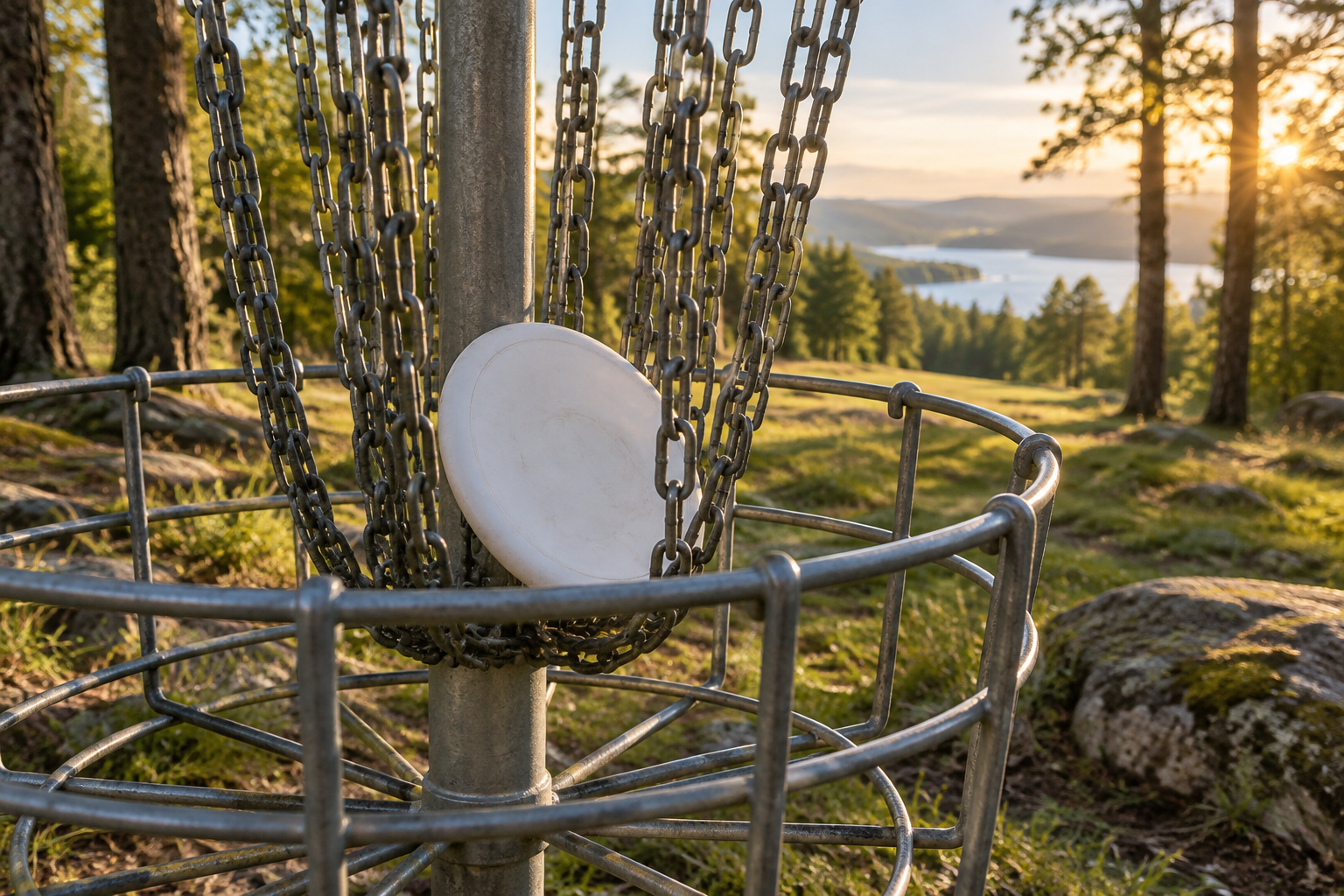
Complete every hole in as few throws as possible. You begin in the teeing area, throw again from where the disc comes to rest, and continue until the disc is supported by the basket tray or chains as required by the rules. Add every throw and any penalty throws. The lowest total score wins.
A standard course often has 18 holes, but 9-hole, 12-hole, 21-hole, and other layouts are common. Par describes an expected score; it does not change the number you record. If you threw four times, write down 4 whether that is a birdie, par, or bogey.
How one hole works
- Check the tee sign. Confirm the correct basket, distance, out-of-bounds areas, mandatory routes, and any special drop zone.
- Tee off. Release the disc while supporting the throw from within the marked teeing area.
- Find every disc. Watch the full flight and use a landmark so the group can locate it quickly.
- Throw from the lie. Away from the tee, your next throwing area is directly behind the marker or the thrown disc. In formal play, the lie is 20 centimeters wide and 30 centimeters deep, centered on the line of play.
- Continue in order. The player farthest from the target normally throws first. Do not walk ahead into a player’s line.
- Hole out. Release the final putt and let it come to rest in the target. In sanctioned play, tapping the chains while still holding the disc does not complete the hole.
Keeping score
Count every competitive throw, including a short missed putt. Then add any penalties. A simple example: drive, approach, missed putt, made putt equals 4. If that hole also carried one penalty throw, the score is 5.
For a casual round, one person can keep a paper or phone scorecard. In PDGA tournament play, current scoring duties are stricter; read the event instructions and the official rulebook rather than assuming the casual system applies.
The beginner stance rules that prevent most mistakes
- On the tee, keep every supporting point within the teeing area at release.
- After the tee shot, have at least one supporting point touching the lie when the disc is released, with no supporting point closer to the target than the back edge of the marker.
- Inside 10 meters of the target, demonstrate balance behind the lie before moving forward. This is why a jump putt near the basket can be illegal.
- Do not move branches or other course features merely because they block your swing. Relief and casual-obstacle rules are specific.
Out-of-bounds, hazards, and mandatory routes
These are different rules, even though each can affect where you throw next. Out-of-bounds normally adds a penalty and gives a new lie under the applicable relief options. A hazard normally adds a penalty while play continues from the disc. A missed mandatory route sends play to the designated drop zone or previous lie with a penalty. The tee sign or tournament notes define the actual areas and routes.
Do not guess at a marked rule. In a casual round, agree on unclear local rules before throwing. In an event, ask your group or an official and use the official provisional procedure when it applies.
Safety and etiquette
- Never throw while someone is within range or hidden around a blind corner. Send a spotter when needed.
- Stand behind the active player, stay still and quiet during the throwing motion, and keep bags away from the lie.
- Watch every throw and help search. Good spotting protects both pace of play and the player’s property.
- Let faster groups play through during casual rounds when the course layout makes it safe. Tournament procedures may differ.
- Pack out trash, respect plants and wildlife, and pause for park users crossing shared space.
A simple first-round version
If the full rulebook feels like too much, remember this: throw only when clear, start at the tee, play from behind the disc, let the farthest player throw, count every throw, and finish in the basket. That is enough to enjoy a safe first casual round. Add formal rules as you play more.
Next: use our first disc golf round checklist or learn what the four ratings mean in disc golf flight numbers.
Sources and further reading
- PDGA Official Rules of Disc Golf
- PDGA Simplified Rules of Disc Golf — useful for learning, but not the ruleset for most sanctioned events.
- PDGA beginner’s introduction to disc golf